
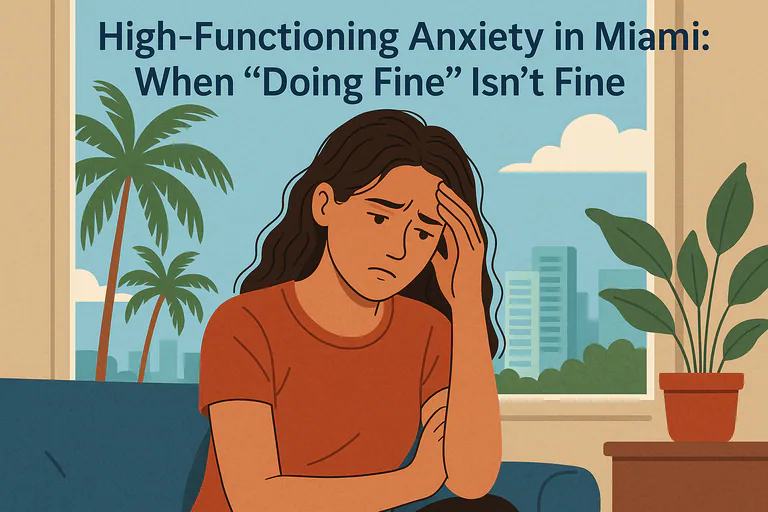
In Miami, the pace can be intense-long workdays, packed social calendars, traffic that tests your patience, and the constant pressure to look like you have it all together. High-functioning anxiety often thrives in environments like this because it hides behind productivity, achievement, and reliability.
You may be getting things done. You may even be “winning” on paper. But inside, it can feel like you’re running on adrenaline, always bracing for the next problem.
High-functioning anxiety isn’t an official diagnosis on its own, but it’s a very real experience-often overlapping with generalized anxiety, perfectionism, or chronic stress.
What Is High-Functioning Anxiety?
High-functioning anxiety is when you appear calm, capable, and successful-while internally dealing with persistent worry, tension, and mental overdrive.
It can look like:
- Always prepared, always early, always “on”
- High achievement and strong work performance
- Being the friend who shows up for everyone
- Organized, responsible, dependable
But feel like:
- Constant worry you can’t shut off
- Fear of disappointing people
- Overthinking every conversation
- A sense that rest must be “earned”
Signs of High-Functioning Anxiety (That People Often Miss)
If you’re waiting for anxiety to look like panic or avoidance, you might miss the quieter signs.
Emotional signs
- You feel guilty when you relax
- You’re “fine”. but rarely peaceful
- You feel irritable, impatient, or on edge
- You have a persistent fear of failure-even when you’re doing well
Mental signs
- Overthinking everything (texts, meetings, decisions, tone of voice)
- “What if” spirals, especially at night
- Difficulty being present because your brain is always planning
- Harsh self-talk masked as “motivation”
Behavioral signs
- Perfectionism and procrastination (yes, both)
- People-pleasing and overcommitting
- Checking/rechecking work, messages, or schedules
- Avoiding vulnerability by staying busy
Physical signs
- Tight chest, shallow breathing, clenched jaw
- Headaches, neck/shoulder tension
- Digestive issues or nausea
- Trouble sleeping (or waking up exhausted)
High-Functioning Anxiety vs. Healthy Ambition
Ambition feels energizing. Anxiety feels urgent.
Healthy ambition:
- You can rest without guilt
- Mistakes don’t destroy your self-worth
- You can say no without panic
- Success is rewarding-not relieving
High-functioning anxiety:
- Rest feels unsafe or “lazy”
- Mistakes feel catastrophic
- Saying no triggers guilt or fear
- You chase relief, not fulfillment
If your drive comes mostly from fear-fear of falling behind, being judged, or losing control-that’s a signal worth taking seriously.
Why It’s Common in Miami (Local Triggers That Fuel It)
Miami has plenty of positives-sun, culture, energy-but it also comes with stressors that can amplify high-functioning anxiety.
Common Miami-specific stressors
- Commuting and traffic pressure (constant rushing, unpredictability)
- High cost of living (financial stress, hustle culture)
- Appearance and status pressure (social comparison, “always on” image)
- Tourism-driven work schedules (hospitality, healthcare, service industries)
- Social intensity (events, nightlife, expectations to be available)
If you feel like you can’t slow down without falling behind, you’re not imagining it. The environment can reinforce the cycle.
The Hidden Cost: What High-Functioning Anxiety Does Over Time
High-functioning anxiety can be “useful” short-term-until it isn’t.
Over time, it can lead to:
- Burnout and emotional exhaustion
- Sleep problems that worsen mood and focus
- Relationship strain (irritability, emotional distance, conflict avoidance)
- Increased risk of depression
- Coping through alcohol, overeating, or constant scrolling
- A life that looks good but feels tight and joyless
Here’s the hard truth: if your coping strategy is “push harder,” your nervous system eventually collects the debt.
Quick Self-Check: Are You Using Productivity to Avoid Anxiety?
Ask yourself:
- Do I feel uneasy when I have nothing scheduled?
- Do I over-explain to avoid someone being upset with me?
- Do I feel like I must be excellent to be accepted?
- Do I survive on caffeine/pressure and crash later?
- Do I feel relief after success-not joy?
If you answered yes to several, you may be operating from anxiety more than you realize.
What Actually Helps (Beyond “Just Relax”)
“Relax” is not a strategy. High-functioning anxiety needs skills and systems-not vague advice.
1) Learn to interrupt the anxiety loop
Try this when your brain starts racing:
- Name it: “This is anxiety, not truth.”
- Narrow it: “What is the actual problem right now?”
- Choose one action: one email, one step, one boundary
Small, specific actions reduce overwhelm better than big motivational pushes.
2) Build a calmer nervous system (not just a better mindset)
High-functioning anxiety is often a nervous system pattern.
Helpful supports:
- Consistent sleep/wake times (even on weekends)
- Daily movement (walks count)
- Protein + hydration early in the day (blood sugar swings mimic anxiety)
- Breathwork you’ll actually do (2 minutes is enough to start)
3) Practice “good enough” on purpose
Perfectionism survives on the belief that mistakes are dangerous.
Pick one area to deliberately do at 80%:
- A casual text reply
- A less-than-perfect email
- Leaving one task unfinished overnight
Your brain learns safety through experience, not logic.
4) Set boundaries that protect your bandwidth
High-functioning anxiety hates boundaries because it equates them with rejection.
Start with scripts:
- “I can’t take that on this week.”
- “I’ll get back to you tomorrow.”
- “I’m not available tonight, but I can do Friday.”
You don’t need a long explanation. Explanations often invite negotiation.
How Therapy Helps High-Functioning Anxiety (What It Looks Like)
Therapy helps by getting underneath the “busy and capable” identity and rewiring the fear-based drivers.
In therapy, you may work on:
- Reducing overthinking and catastrophizing
- Shifting perfectionism and performance-based self-worth
- Addressing people-pleasing and boundary issues
- Building emotional regulation skills
- Processing underlying stress, trauma, or chronic pressure patterns
- Creating a sustainable lifestyle-not just a successful one
Approaches often used:
CBT (Cognitive Behavioral Therapy)
Helps identify thinking distortions, challenge fear-based assumptions, and change behaviors that reinforce anxiety.
ACT (Acceptance and Commitment Therapy)
Helps you stop fighting your thoughts and start living by your values-without anxiety running your decisions.
Mindfulness-based strategies
Build presence and reduce compulsive mental “future scanning.”
If anxiety is affecting sleep, relationships, work performance, or enjoyment-therapy isn’t overkill. It’s maintenance for your mental system.
When to Get Help (Not When You’re “Worse Enough”)
You don’t need to wait for a breakdown.
Consider reaching out if:
- Your mind rarely feels quiet
- Rest makes you anxious
- You’re functioning but not thriving
- You’re using substances, food, or scrolling to numb out
- Your relationships are strained by irritability or shutdown
- You feel like your life is on autopilot
High-functioning anxiety is often the last “acceptable” struggle people admit. That’s exactly why it lingers.
Getting Support in Miami
Miami has a strong mental health community, including options for:
- In-person therapy across Miami-Dade
- Telehealth therapy if commuting is a barrier
- Therapy that’s culturally responsive (important in Miami’s diverse communities)
- Flexible scheduling for demanding work hours
If you’re in Miami and recognize yourself in this, the goal isn’t to become less capable. It’s to become capable without suffering internally.
FAQs About High-Functioning Anxiety
Is high-functioning anxiety the same as generalized anxiety disorder (GAD)?
Not necessarily. Many people with high-functioning anxiety meet criteria for GAD, but the term often describes the “looks fine on the outside” presentation.
Can high-functioning anxiety turn into burnout?
Yes. If your nervous system runs on constant pressure, burnout is a common outcome.
Does medication help?
Sometimes. Medication may reduce intensity of symptoms, especially if anxiety is severe or persistent. Many people benefit from therapy alone or a combined approach.
How long does therapy take?
It depends on severity and goals. Some people see improvement in weeks; deeper patterns take longer. The key is consistency and the right fit.
Bottom Line
High-functioning anxiety is not a personality trait you’re stuck with-it’s a pattern your brain and body learned to survive pressure. You can keep your ambition and still build peace.
If your success comes with constant tension, this is your sign: don’t normalize suffering just because you’re functioning.