
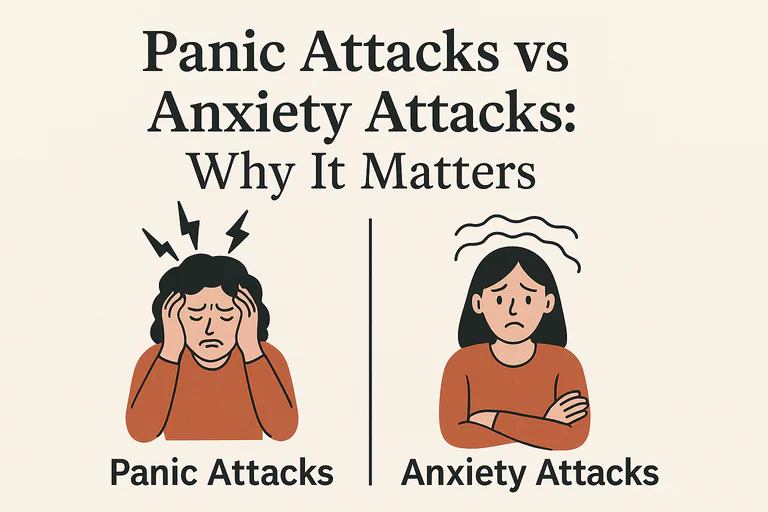
If you’ve ever felt your heart slam, your breathing tighten, and your brain scream “something’s wrong,” you’re not alone. A lot of people in Miami experience intense anxiety symptoms-especially with fast-paced work, traffic stress, nightlife schedules, and high daily demands.
But here’s the problem: panic attacks and “anxiety attacks” aren’t the same experience, and confusing them can lead to the wrong coping strategy.
- Panic attacks are typically sudden and intense.
- Anxiety attacks are usually a build-up of stress and worry that spills over.
Knowing which one you’re dealing with helps you respond faster-and with less fear.
What Is a Panic Attack?
A panic attack is a sudden surge of intense fear or discomfort that peaks quickly (often within minutes). It can feel like:
- A heart attack
- Losing control
- Passing out
- “I’m going to die”
Common panic attack symptoms
- Racing heart, chest tightness
- Shortness of breath, choking sensation
- Dizziness, lightheadedness
- Sweating, shaking
- Nausea, stomach distress
- Tingling or numbness
- Feeling unreal/detached (derealization/depersonalization)
- Fear of dying or “going crazy”
Important: Panic attacks are terrifying, but they are not usually dangerous. Your nervous system is firing a false alarm.
What People Mean by “Anxiety Attack”
“Anxiety attack” isn’t an official medical term, but it’s commonly used to describe a spike in anxiety that builds from ongoing stress.
Common anxiety attack experience
- Worry snowballs for hours or days
- You feel keyed up, restless, on edge
- Your mind loops through worst-case scenarios
- You may cry, shut down, or feel overwhelmed
Common symptoms
- Muscle tension, headaches, jaw clenching
- Trouble sleeping
- Irritability
- Racing thoughts
- Stomach issues
- Feeling “revved up” but exhausted
Panic Attack vs Anxiety Attack: The Fast Comparison
How it starts
- Panic attack: sudden, often “out of nowhere”
- Anxiety attack: builds up from stressors and worry
How intense it feels
- Panic attack: extreme intensity, peak quickly
- Anxiety attack: intense but usually less “I’m dying” level
How long it lasts
- Panic attack: usually peaks within minutes, then fades
- Anxiety attack: can linger for hours or longer
What drives it
- Panic attack: fear response + body sensations amplify fear
- Anxiety attack: cognitive worry + stress load amplify symptoms
Miami-Localized Triggers (Real Life, Not Theory)
Miami has some specific anxiety fuel. These are common triggers I see people describe:
Panic triggers
- Being stuck in heavy traffic on I-95 or the Palmetto and feeling trapped
- Crowded venues in Brickell, Wynwood, South Beach (heat + noise + tight spaces)
- Caffeine + dehydration (easy in Miami heat)
- Hangovers, stimulants, or poor sleep after late nights
- High-intensity workouts followed by body sensations (fast heart rate can mimic panic)
Anxiety build-up triggers
- Work pressure in fast-moving industries (hospitality, healthcare, real estate, service)
- Financial stress from cost of living
- Constant social comparison (“I should be doing more / looking better / achieving more”)
- Family obligations across cultures and generations (common in Miami households)
- Endless stimulation: events, late nights, screens, and not enough recovery
Here’s the blunt truth: heat, dehydration, caffeine, and sleep debt can take mild stress and turn it into full-body panic quickly.
What To Do During a Panic Attack (Step-by-Step)
Panic is a body event first. Your job is to stop feeding it danger signals.
Step 1: Stop chasing certainty
Don’t argue with your brain. Don’t try to “prove” you’re safe. That keeps the loop alive.
Say this instead:
- “This is panic. It will pass.”
- “My body is uncomfortable, not unsafe.”
Step 2: Fix your breathing (but do it right)
Most people try to take huge breaths. That can worsen symptoms if you’re already over-breathing.
Try:
- Breathe in gently through your nose for 4
- Breathe out slowly for 6
- Repeat for 10 cycles
Longer exhale signals your nervous system: “stand down.”
Step 3: Ground your senses (pull your brain out of the spiral)
Pick one:
- Name 5 things you see, 4 you feel, 3 you hear, 2 you smell, 1 you taste
- Press your feet into the ground and describe the sensation in detail
Step 4: Reduce adrenaline with movement (small + controlled)
If you can:
- Walk slowly
- Roll your shoulders
- Shake out your hands for 20 seconds
Your body needs a physical “completion” signal for the stress response.
Step 5: Don’t escape in a panic (when possible)
If you always flee the situation, your brain learns: “That place is dangerous.”
If you can stay safely, even for 2 more minutes, you teach your brain: “I can survive this.”
What To Do During an Anxiety Attack (When It’s a Build-Up)
Anxiety spikes from mental overload + stress habits. You need structure, not willpower.
Step 1: Shrink the problem
Ask:
- “What is the problem today, not forever?”
- “What’s the next smallest action?”
Write one sentence. One action. No giant plan.
Step 2: Dump the thoughts (get them out of your head)
Set a timer for 7 minutes and write:
- What I’m afraid of:
- What I can control:
- What I can do next:
This reduces the mental “open loops” that keep anxiety running.
Step 3: Use a hard boundary on rumination
Pick a phrase:
- “Not solving this right now.”
- “I’ll think about this at 6pm.”
Then redirect to a physical task (shower, walk, dishes). Anxiety hates embodiment.
Step 4: Reduce stimulants that mimic anxiety
This matters a lot in Miami:
- Hydrate
- Eat something with protein
- Cut caffeine after midday
- Avoid “hangxiety” cycles (alcohol ? poor sleep ? anxiety spike)
When to Go to the ER (Don’t Ignore Red Flags)
Most panic symptoms are not dangerous-but you should seek urgent medical care if you have:
- New chest pain, especially with exertion
- Fainting, severe shortness of breath, or severe weakness
- Symptoms that feel different from your typical panic
- A known heart condition or major risk factors
If you’re unsure and it’s your first episode, getting checked is reasonable. After medical causes are ruled out, treatment can focus on preventing recurrence.
How Therapy Helps (So This Doesn’t Keep Hijacking Your Life)
The worst part of panic is often fear of the fear:
- “What if it happens again?”
- “What if I embarrass myself?”
- “What if I can’t breathe?”
That avoidance can shrink your world quickly.
Therapy can help you:
- Understand your panic cycle (body sensations ? catastrophic thoughts ? more sensations)
- Reduce safety behaviors (checking pulse, constant reassurance)
- Learn interoceptive exposure (practicing sensations safely so they stop being “danger”)
- Build stress resilience if anxiety is the underlying driver
Common approaches:
- CBT for panic/anxiety patterns
- ACT for reducing struggle with thoughts and sensations
- Exposure-based work for avoidance and fear conditioning
FAQs
Can panic attacks happen “for no reason”?
They can feel like that, but often there are hidden triggers: stress load, sleep debt, caffeine, dehydration, hormonal shifts, or subtle body sensations misread as danger.
How do I know if it’s a heart attack or panic?
Symptoms can overlap. If it’s new, severe, or you have risk factors-get medical evaluation. Once medical causes are ruled out, panic becomes much more likely.
Do panic attacks mean I have a panic disorder?
Not necessarily. Panic disorder usually involves repeated panic attacks plus persistent fear and behavior changes to avoid them.
Can medication help?
Sometimes-especially if panic is frequent or disabling. Many people also do very well with therapy alone or therapy plus medication.
Bottom Line
If it hits suddenly and peaks fast, think panic and calm the body first.
If it builds from stress and worry, think anxiety spike and reduce mental overload + strengthen boundaries.
Either way, you don’t need to “tough it out.” If panic or anxiety is controlling your choices in Miami-where you go, how you work, how you sleep-getting support is a practical move, not a dramatic one.