
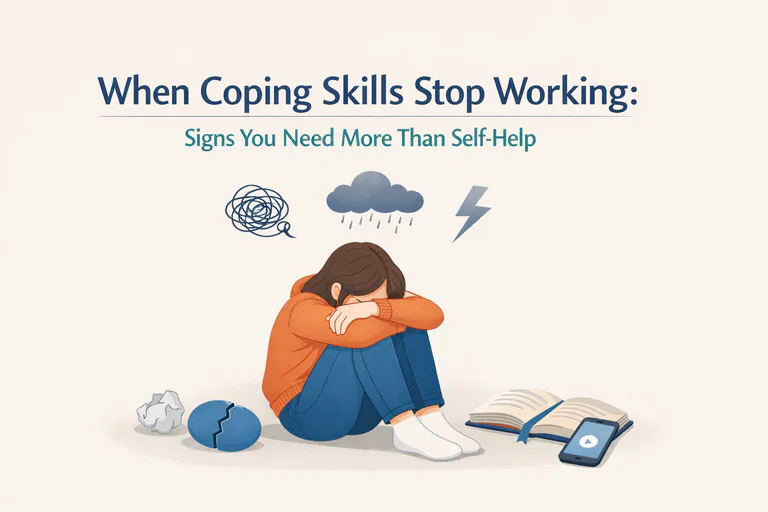
When Coping Skills Stop Working: Signs You Need More Than Self-Help

Home / Blog

Most people think coping skills are the endpoint. They’re not. They’re a bridge — and at some point, that bridge stops being safe and starts becoming the very thing that traps you.

This isn’t about “feeling better.” It’s about functioning versus healing — and knowing when to stop patching and start treating.

Why This Matters (Urgent, Not Gentle)

You can accumulate coping strategies forever — journaling, meditation, exercise, mindfulness videos — and still get worse.

Here’s the brutal truth:

  • Coping skills manage symptoms.
  • They don’t get at the drivers of anxiety, depression, trauma, avoidance, addiction, self-esteem wounds, or relational dysfunction.
  • When those drivers strengthen, coping becomes denial with good branding.

So you need to know when coping stops protecting you and starts preventing real recovery.

You’re Exhausted Instead of Improved

A common myth:

“If I’m doing all the self-care stuff, I should feel better.”

Reality check:
Coping skills temporarily relieve distress but don’t reduce root stress load.

If you’re:

  • Tired all the time,
  • Never energized,
  • Only “okay” when distracted,

…that’s not resilience. It’s compensatory fatigue — a sign coping isn’t working anymore.

Symptoms Return Faster and Stronger

When coping is effective, distress spikes less often and eases quicker.

But if you notice:

  • Episodes are lasting longer,
  • Triggers are multiplying,
  • You need more coping to get the same effect,

…that’s not progress. It’s escalation.

Your Coping Is Avoidance in Disguise

Real coping addresses stress directly.

Avoidance looks like:

  • Overworking so you don’t feel
  • Constant busyness
  • Social withdrawal masked as “recharging”
  • Bingeing on distraction (scrolling, TV, substances)

Ask yourself:

“What am I trying not to feel right now?”
If the answer isn’t addressed — you’re avoiding.

Avoidance preserves distress; it doesn’t resolve it.

You Know You Need Help — But You Wait for “Perfect Timing”

Procrastination isn’t always laziness. It can be:

  • fear of vulnerability
  • fear of change
  • fear of being wrong
  • fear of failure
  • fear of confronting deeper pain

If fear delays action — it’s a signal, not a permission slip to wait.

Coping Skills Are Creating New Problems

This is the moment most people miss.

For example:

  • Exercise becomes compulsive
  • Meditation becomes numbing
  • Journaling becomes rumination
  • Healthy routines become rigid rules

When coping begins to control you instead of support you — it’s no longer coping. It’s avoidance with better packaging.

You’ve Plateaued — For Months or Years

Plateaus in healing aren’t neutral. They’re stagnation — especially when accompanied by:

  • Little to no emotional growth
  • Repeating the same patterns
  • Same triggers, same outcomes
  • Minimal shifts in relationships

Growth should be uncomfortable, not static.

You Feel Relief Only When Distracted

If your peace comes only when you’re doing something — that means:

  • You haven’t learned to sit with discomfort
  • You’re not processing underlying emotions
  • You’re surviving moments, not transforming them

Coping skills give temporary relief. Therapeutic processing changes the nervous system.

So What Actually Works Beyond Coping?

Therapeutic Treatment Isn’t Optional — It’s Strategic

You don’t go to a physical therapist for breathing exercises alone when your knee is broken.

Mental health is the same.
You need more than:

  • Tips
  • Tricks
  • Temporary fixes

You need structured engagement with:

  • Assessment
  • Diagnosis (if relevant)
  • Targeted interventions
    — CBT, DBT, EMDR, ACT, somatic approaches, etc.
  • Accountability

Therapy Does Things Coping Can’t

  1. It identifies patterns you can’t see
  2. It rewires responses, not just relieves symptoms
  3. It increases tolerance for discomfort
  4. It builds skills that change your default reactions

How to Know It’s Time to Book — Right Now

Answer these honestly:

  1. Is distress interfering with your decisions?
  2. Are relationships deteriorating?
  3. Are coping strategies the only reason you’re functioning?
  4. Do you secretly want change but avoid action?

If yes — you’ve outgrown coping.

Immediate Next Step (Action Plan)

  1. List 3 core complaints you’ve been living with for more than 6 months.
  2. Rate their intensity and frequency.
  3. Schedule an assessment with a licensed clinician.
    (Renova offers structured intake and personalized plans.)

Don’t wait until relief becomes regret.

Conclusion — A Sharp Reality

Coping skills are tools — not cures.

They’re excellent when:

  • You’re early in distress
  • You need temporary relief

They’re inadequate when:

  • You’re stuck
  • You avoid
  • You plateau
  • Your life is functioning by proxy

The fact that coping worked enough for long enough doesn’t mean it’s working now.

If your quality of life hasn’t improved in months — it’s not resilience. It’s resistance.

Effective healing begins where coping stops.

If you’re reading this — that point may be now.