
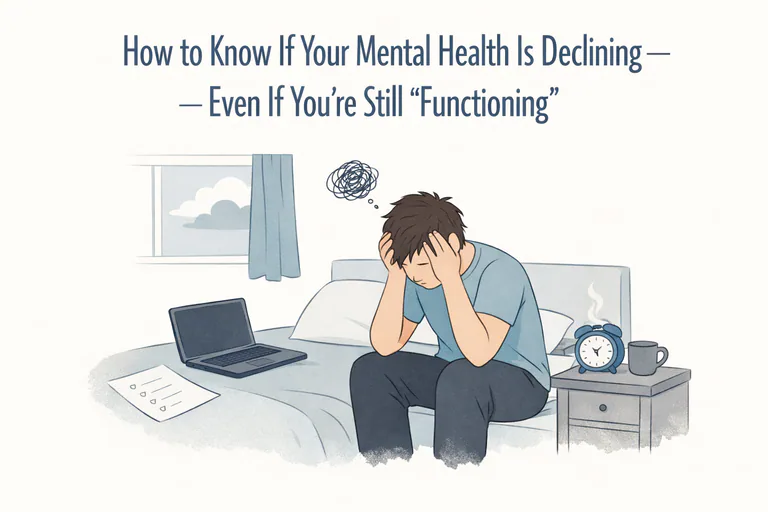
Many people don’t seek help because nothing is “wrong enough.”
They’re still working.
Still parenting.
Still showing up.
Still paying bills.
So they assume they’re fine.
They’re not.
Functioning is not the same as being well.
It’s often the last thing to break.
Why “I’m Still Functioning” Is a Dangerous Standard
Functioning only measures one thing:
Can you still perform tasks under pressure?
It says nothing about:
- emotional health
- nervous system regulation
- relational capacity
- long-term sustainability
Plenty of people function right up until they collapse – mentally, emotionally, physically, or relationally.
Decline rarely looks dramatic at first.
It looks manageable.
Early Signs of Mental Health Decline People Ignore
These don’t feel like emergencies. That’s the problem.
Emotional Range Is Narrowing
You’re not constantly distressed – but you’re not really okay either.
Signs:
- joy feels muted
- excitement is brief
- sadness turns into numbness
- irritability replaces feeling
This isn’t balance.
It’s emotional shutdown.
Stress Tolerance Is Shrinking
Things you used to handle now feel heavier.
You notice:
- less patience
- faster overwhelm
- stronger reactions to small stressors
- difficulty recovering after stressful days
This is nervous system fatigue – not weakness.
You Rely on Distraction to Feel Normal
You feel “fine” only when:
- busy
- entertained
- stimulated
- occupied
Stillness feels uncomfortable.
Silence feels loud.
That’s not preference – it’s avoidance.
You’re Functioning on Pressure, Not Choice
Motivation exists, but it’s driven by:
- urgency
- guilt
- fear of letting others down
- fear of falling behind
When pressure disappears, so does momentum.
That’s not discipline.
It’s survival mode.
Relationships Feel Like Work, Not Support
You may still show up – but with less capacity.
Signs:
- social withdrawal
- emotional distance
- irritability with loved ones
- avoiding deeper conversations
- feeling misunderstood but not clarifying
Decline often shows up relationally before it shows up anywhere else.
Rest Doesn’t Restore You
You sleep.
You take time off.
You slow down.
And you’re still tired.
That’s not lack of rest.
That’s chronic depletion.
Why People Stay in This Stage Too Long
Because decline here is:
- quiet
- gradual
- explainable
- rationalizable
People tell themselves:
- “This is just adulthood.”
- “Everyone feels like this.”
- “It’s not that bad.”
- “I’ll deal with it later.”
Later is when treatment is harder.
What Happens If You Ignore This Stage
Mental health decline doesn’t stabilize on its own.
It progresses into:
- anxiety disorders
- depression
- burnout
- panic symptoms
- emotional numbness
- relational breakdown
- physical symptoms
By the time functioning drops, the system is already overloaded.
Early intervention isn’t dramatic – it’s strategic.
Why High-Functioning People Miss the Window
If you’re competent, capable, and responsible, you’re more likely to:
- push through discomfort
- minimize distress
- normalize overload
- delay asking for help
Your strengths buy time – not immunity.
How to Tell If It’s Time to Act (Not Wait)
Ask yourself honestly:
- Am I living, or managing?
- Does my life feel sustainable?
- Do I feel connected or just productive?
- Am I adapting – or deteriorating quietly?
- If nothing changes, will this be better or worse in a year?
If the answer isn’t clear – that’s your answer.
What Early Support Actually Does
Intervening now:
? prevents symptom escalation
? restores emotional range
? rebuilds stress tolerance
? improves relationships
? reduces long-term treatment intensity
Waiting doesn’t make therapy easier.
It makes it longer.
Final Reality Check
You don’t need to be falling apart to deserve help.
You need to be paying attention.
Functioning is not health.
Endurance is not wellness.
Survival is not living.
If you’re still functioning but quietly declining, the most responsible move isn’t waiting.
It’s intervening before your system forces you to.